

Almost all things, including clothing, toys, gadgets, appliances, and even food, are seasonal in nature. Seasonality is prevalent in company strategy development to help make the most of a year’s sub-divisions. These seasons present enormous prospects for businesses and are hence crucial for revenue and break evens. Seasonality distinguishes any product or service from the competition and provides businesses with a competitive advantage.
“The proclivity of consumer spending on a commodity or service to change in a predictable fashion over the course of a year.”
A good marketer will never pass up an opportunity to increase a product’s sales and earnings. This is frequently backed up by a spike in sales, which occurs during the peak season for certain items or services, as opposed to the off-season or non-peak season. But it’s the perfect timing to harness these seasons and get the best of them that’s crucial.
Objective
This research was carried out for a variety of reasons.
- To comprehend what seasonal marketing entails.
- Investigate the significance of seasonal marketing
- To research the various marketing seasons
- To investigate the various strategies for seasonal marketing.
- Examine some well-known seasonal marketing examples
Methodology
This paper is a Descriptive Research attempt. Secondary sources, such as newspaper articles, journals, books, and websites, are used to compile the data.
Concept
Seasonality is a property of a time series in which the data undergoes predictable and recurring changes across the calendar year. Seasonal refers to any predictable shift or pattern in a time series that recurs or repeats over a one-year period, according to Investopedia.
Seasonality is one of the elements that causes swings in website traffic and revenues. Good marketers are individuals who put up the necessary effort to get the most out of it in order to reap the benefits of increased sales. Seasonal marketing entails tailoring marketing campaigns to current events.
Alternatively, the industry could be targeted during key events and national or international holidays. Looking at the calendar, researching the days, recognizing acceptable chances, and then capitalizing on them is all part of seasonal marketing.
Seasonal marketing works well for B2C businesses since customers are involved on one end, buying items based on seasons, as opposed to B2B enterprises, which are often commercial rather than user-oriented.
New Year’s, Christmas, Easter, Mother’s Day, Valentine’s Day, and Halloween are the most popular marketing seasons worldwide. Domestic festivities such as Diwali, Holi, Raksha Bandhan, Ganesh Chaturthi, Eid, and regional festivals such as Pongal, Baisakhi, and Durga Puja are held in India.
As a result, Indians benefit from having a varied nation, which presents enormous opportunities for both domestic and multinational marketers. Some businesses, such as AkshayaTritya for jewelry and Dhanteras for kitchenware, have developed auspicious purchasing strategies. To be crystal clear and effective, you must understand web traffic seasonality.
Seasonality in web traffic refers to the predictable, yearly increasing and decreasing trends in search results that shift throughout the year. As a result, seasonal marketing necessitates doing studies and planning actions ahead of time in order to be prepared for the approaching season.
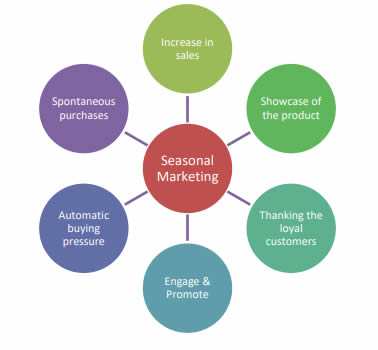
Seasonal Marketing’s Importance
Changing times necessitate new tools and techniques, and seasonal marketing assists businesses in adapting to seasonal changes based on current traffic and planning. Marketers seldom miss an opportunity to cultivate positive relationships with their customers, and CRM is growing unparalleled popularity in the age of social media. Seasonal marketing has a number of distinct advantages, including:
When there are sales or celebrations, shoppers become weak and end up buying items in a frenzy. Seasonal marketing thus serves as a trigger for increasing sales while also ensuring that the expense of marketing is covered.
For example, because it is an auspicious season of festivities, most electronic companies provide a huge number of bargains during Diwali. Greeting cards and confectioneries sell at their highest levels throughout the holiday season.
Display of the Product
Marketing is an excellent technique for showcasing what is available. So, with seasonal marketing hoardings, there can be a display of the numerous items that clients can buy, and so it serves as an informational campaign as well.
For example, when the year draws to a close, most businesses send their own calendars, which feature their products as well as wishes to their clients.
Alternatively, Halloween is the only time of year when such costumes can be displayed, advertised, and sold.
Thanking Our Consistent Clients
Because customer loyalty is so important to any business in terms of maintaining ongoing and future sales, most marketers use this moment to express their gratitude to these customers through various marketing strategies. During Dhanteras, for example, most jewellers give away a gold coin or offer discounts on manufacturing costs.
Promote and engage your audience.
Marketing is incomplete without promotion. Seasonal marketing gives businesses and their sales the boost they need while also involving customers in the product acquisition process.
Valentine’s Day, for example, entails gifts for partners. Valentine’s Day promotions encourage purchases for and by loved ones, while also emphasizing the emotional aspect of the occasion. This not only promotes the goods or presents, but it also keeps customers engaged.
Alternatively, anytime there are movie releases around a specific season, such as the Fifty Shades of Grey trilogy, which has been released near Valentine’s Day around the world, renowned Bollywood stars make appearances.
Purchasing Pressure that is Automatic
Summers are the season of cottons, linens, and air conditioners, while winters are the season of heaters, shawls, and knits. Festivals are joyous occasions that frequently entail excessive spending for personal or gift-giving purposes. Diwali parties are popular in India, while New Year’s and Christmas festivities are popular overseas.
Santa Clause and surprises are generally linked with Christmas. In such festive seasons, parents are often under automatic pressure to spend. When the weather gets colder.
Purchases made on the spur of the moment
ALDO India has announced a 1+1 deal on its bags, footwear, and accessories as part of a winter special promotional plan. This deal was seen at most major malls across India, and it resulted in a large number of spontaneous purchases from the mall’s footfall by customers who suddenly purchased these things.
Because most buyers are deal breakers and welcome such marketing agendas with open arms for personal gains, such promotions lead to a variety of unplanned purchases and hence increased sales for the company.
